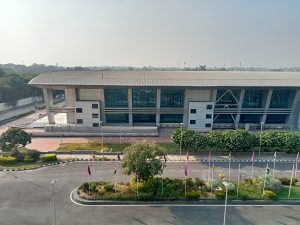


Jamia Millia Islamia (JMI) — the Central University tucked away in Jamia Nagar, New Delhi — has firmed up its UG Admission 2026 cycle, and a significant slice of its undergraduate seats are now allotted purely on the basis of CUET UG 2026 normalised scores. If you are sitting in the middle of the CUET exam window right now (Day 2 was yesterday, 11 May), JMI deserves a serious spot on your preference list — partly for its Central University status, partly for its A++ NAAC grade, and largely because its CUET-linked cutoffs are typically more reachable than DU’s North Campus colleges for the same programme.
This guide walks you through the JMI CUET 2026 application window, the exact list of UG courses admitting through CUET, eligibility, the JMI-specific reservation matrix, expected cutoffs and the post-result counselling drill — written for the aspirant who has already submitted the CUET form and now wants to plan the JMI form-fill phase that follows the result.
JMI UG Admission 2026: Quick Snapshot
Before we go deeper, a one-screen view of what 2026 looks like at Jamia:
- Application window: 20 February 2026 → 25 March 2026 (closed). The portal stays open as a reference at admission.jmi.ac.in.
- CUET dependence: Around 20 UG programmes use CUET UG 2026 scores; the rest go through JMI’s own Entrance Test (26 April – 5 June 2026).
- Mandatory two-step process: CUET form + JMI online admission form. Skipping the JMI form means your CUET score is ignored — this trips up roughly one in three aspirants every year.
- Counselling start: Expected first week of August 2026, after CUET results.
- Result/cutoff release: Published programme-wise on jmi.ac.in after the NTA declares CUET UG 2026 scores.
UG Programmes at JMI Admitting Through CUET 2026
JMI has officially listed eight headline UG subjects under CUET intake, but with honours specialisations the count rises to roughly 15 programmes. The cleanest way to read this list is by faculty:
- Faculty of Social Sciences: B.A. (Hons) Economics, B.A. (Hons) History, B.A. (Hons) Political Science, B.A. (Hons) Sociology, B.A. (Hons) Psychology, B.Com (Hons).
- Faculty of Humanities & Languages: B.A. (Hons) Hindi, B.A. (Hons) Sanskrit, B.A. (Hons) French & Francophone Studies, B.A. (Hons) Spanish & Latin American Studies.
- Faculty of Natural Sciences: B.Sc. (Hons) Physics, B.Sc. (Hons) Mathematics, B.Sc. Biotechnology.
- B.Voc programmes: Solar Energy, Auto Mechanic and Diesel Mechanic, Printing Technology — the underrated, employment-linked stream that almost no Delhi aspirant looks at.
Programmes such as B.Tech, B.Arch, B.Ed, B.P.T., BDS, BUMS, MBBS and Mass Communication (BA Hons) are NOT admitted via CUET — JMI conducts its own entrance for these. So if your dream is Jamia’s celebrated AJK Mass Communication Research Centre, the CUET route will not take you there.
Eligibility: Class 12 Marks & Subject Mapping
For CUET-route UG programmes, JMI broadly demands:
- 50% aggregate in Class 12 from a recognised Board for most programmes; some honours courses lift the bar to 60%.
- Domain subject in CUET: You must appear in the CUET domain paper matching your chosen course. For B.A. (Hons) Economics, the safest combination is one language + Economics + Mathematics + General Test. For B.Sc. (Hons) Physics, take a language + Physics + Mathematics + one more science domain.
- 5-subject ceiling: From CUET UG 2026, you can select a maximum of 5 subjects. Pick wisely so all your JMI courses-of-interest stay covered.
If you are still polishing those domain subjects, our CUET Economics — Macroeconomics: Money, Banking & National Income notes and the CUET Political Science — Indian Government NCERT notes are pinned to the JMI syllabus map and worth a revision pass.
JMI Reservation Policy: Different from DU and BHU
This is where JMI quietly diverges from every other CUET-accepting Central University and the reason a moderate-scoring aspirant can still land a Jamia seat. JMI carves seats as:
- 30% — Muslim Minority applicants (the defining JMI quota).
- 10% — Muslim Women (sub-quota).
- 10% — Muslim OBC/ST (sub-quota).
- Remaining 50% — Open (with internal SC/ST/OBC-NCL/EWS/PwBD splits as per Government of India rules).
If 10% of seats in the Muslim Women or Muslim OBC categories remain unfilled, they roll up to the Muslim Minority pool. If even that pool stays unfilled, those seats finally transfer to the Open category — so non-Muslim aspirants quietly benefit in subjects where Muslim Minority candidates do not apply in volume (typically Sanskrit, Hindi and some B.Voc streams).
Expected CUET Cutoffs at JMI for 2026
Cutoffs at JMI move on a much wider spread than DU. Based on the 2025 cycle and our internal modelling of the 2026 normalisation pattern:
- B.A. (Hons) Economics: General — 73 to 77 percentile; OBC-NCL — 68 to 72.
- B.Com (Hons): General — 70 to 74; Muslim Minority — 58 to 64.
- B.A. (Hons) Political Science / Sociology: General — 65 to 70.
- B.Sc. (Hons) Physics / Mathematics: General — 60 to 68 (the lower band reflects smaller applicant pools versus DU).
- B.Voc programmes: 40 to 55, often the easiest CUET-route Central University seat in Delhi.
These are indicative ranges; JMI publishes the final cutoff list programme-wise after NTA releases the CUET UG 2026 scorecard.
JMI Fee Structure 2026: What It Actually Costs
- UG fees: ₹23,175 to ₹6,20,800 across the full course duration — the upper band kicks in only for self-financed seats in B.Tech-style programmes.
- B.Sc. (Hons): ₹23,400 – ₹6,19,600 cumulative.
- Hostel: ₹25,550 – ₹28,350 per year (mess + room + utilities). The on-campus halls are heavily oversubscribed; budget for off-campus PG if you cannot secure a hostel seat in round 1.
How JMI Sits Alongside Other CUET Universities
Many CUET 2026 aspirants stack JMI with DU and JNU on the same preference list. The trade-offs:
- JMI vs DU: Lower cutoffs at JMI for the same programme; comparable A++ academic grade; smaller cohort means closer faculty access. If you also need DU’s CSAS workflow, our DU CSAS 2026 portal walkthrough covers the parallel form-fill.
- JMI vs JNU: JNU’s UG basket is narrower (mostly foreign languages and B.Sc.-M.Sc. integrated); JMI has a broader Humanities and Commerce spread. Cross-reference our JNU UG Admission 2026 guide.
- JMI vs BHU: BHU has a much wider programme list, but Varanasi vs Delhi is a lifestyle and cost decision. The BHU UG Admission 2026 guide spells out the comparison.
Step-by-Step: The Post-CUET JMI Form Drill
- CUET UG 2026 result is declared on cuet.nta.nic.in (expected late June – early July 2026).
- Log in to admission.jmi.ac.in using the credentials you had created during the February application window.
- Upload your CUET scorecard PDF, Class 12 marksheet, category certificate (if applicable) and a recent photograph and signature.
- Lock your preference order — JMI uses a strict preference-cum-merit allotment; the order you submit is final and cannot be changed during seat allotment rounds.
- Wait for the merit list (early August 2026); if allotted, pay the admission fee within 72 hours or the seat moves to the waitlist.
- Report to campus for document verification on the allotted date — virtual verification is no longer accepted from 2026 onwards.
What to Do This Week
You are mid-CUET right now. The realistic JMI checklist for the next seven days:
- Today (Tue): Confirm your CUET admit-card subject combination already includes the domain papers JMI needs for your top three preferences.
- By Friday: Save the JMI admission portal login + password in your phone vault — every year hundreds of allotments lapse because aspirants forget the credentials by August.
- This weekend: Make a Plan B preference matrix combining JMI + DU + JNU + BHU. Don’t put all four eggs in DU’s basket; JMI’s cutoffs are quietly your safety net.
FAQs — JMI UG Admission 2026 via CUET
Q1. Do I still need to fill a separate JMI form even after appearing for CUET UG 2026?
Yes. CUET registration alone does NOT make you a JMI applicant. You must complete the JMI online admission form on admission.jmi.ac.in within the prescribed window for your CUET score to be considered.
Q2. What is the minimum CUET percentile required to get into B.A. (Hons) Economics at JMI?
Based on the 2025 cycle, General-category candidates needed roughly 73–77 percentile, with category-wise relaxations of 4–8 percentile points. The 2026 list will be programme-specific and released after results.
Q3. Is JMI’s Muslim Minority quota a religious entrance test?
No. It is a seat-reservation category governed by the National Commission for Minority Educational Institutions Act, not a religious entrance test. You submit the same CUET score; only the merit list is segmented.
Q4. Can I take admission in B.Tech or Mass Communication at JMI using my CUET 2026 score?
No. B.Tech, B.Arch, BDS, MBBS, BUMS, B.P.T., B.Ed and Mass Communication run through JMI’s own entrance test (26 April – 5 June 2026), not CUET. Plan separately for those streams.
Q5. Will I lose my JMI seat if I do not report physically for document verification?
From the 2026 cycle onwards, JMI has discontinued virtual verification. Failure to report on the allotted date forfeits the seat, and it rolls to the next waitlisted candidate.
Practice MCQs — JMI & CUET Quick-Fire
- Which of these JMI UG programmes does NOT admit via CUET 2026? a) B.A. (Hons) Economics b) B.Sc. Biotechnology c) B.Tech Civil d) B.Com (Hons). Answer: c)
- The Muslim Minority reservation at JMI is approximately: a) 10% b) 20% c) 30% d) 50%. Answer: c)
- The JMI admission portal URL is: a) jmi.nic.in b) admission.jmi.ac.in c) jamia.delhi.gov.in d) cuet.jmi.in. Answer: b)
- The CUET UG 2026 maximum subject limit is: a) 3 b) 4 c) 5 d) 6. Answer: c)
- JMI counselling for CUET-route UG seats is expected to begin in: a) June 2026 b) July 2026 c) August 2026 d) October 2026. Answer: c)
Stay locked in. The JMI window quietly opens once CUET results drop — and the aspirants who pre-empt the form-fill are the ones who finish August with an offer letter, not a regret.