

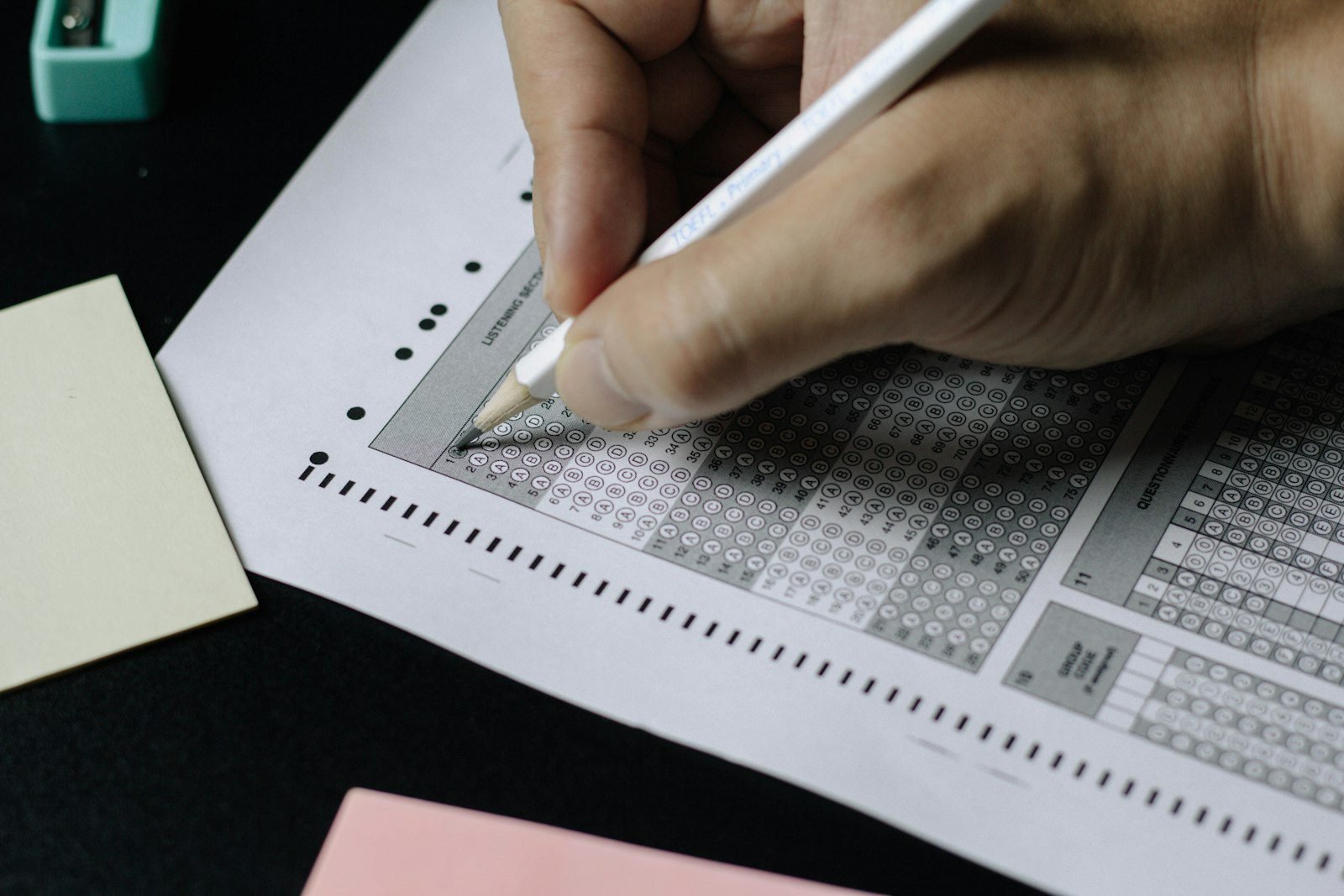
The CUET UG 2026 exam window is mid-flight (11 May – 31 May), and within roughly a fortnight of your last shift, the National Testing Agency (NTA) will quietly drop three of the most consequential PDFs of your admission cycle on cuet.nta.nic.in: your recorded OMR/response sheet, the provisional answer key, and the question paper. Most aspirants treat this window as a passive “let me check my score” exercise. That is the costliest mistake of the entire cycle. This is the only chance the system gives you to challenge a wrongly recorded bubble, a disputed answer, or a misprinted question — and the window typically stays open for just 48–72 hours. Miss it, and the final answer key becomes your fate. This guide walks you through the entire OMR & objection workflow, ₹200/question and all.
Why the OMR Response Sheet Window Decides Your CUET Score
Unlike Boards, where you can apply for re-evaluation weeks later, NTA’s CUET process is a one-shot deal. Once the final answer key is issued (tentatively first week of July 2026), no further challenges are entertained — not by NTA, not by the courts in most cases. The provisional-key window is your only judicial moment. The 2025 cycle saw lakhs of candidates skip the objection step entirely, only to find at result time that 2–3 questions per subject had been dropped or revised — and they had silently accepted the lower of the two outcomes. A diligent objection on even one genuinely wrong key entry can mean +5 marks (or saving -1) — enough to flip a DU St. Stephen’s English (Hons) cutoff or a JNU language seat.
CUET UG 2026 Answer Key Timeline: What Drops, When
Going by the 2024 and 2025 cycles, here is the realistic NTA schedule you should plan around:
- Recorded responses (your OMR/CBT capture): Second–third week of June 2026 on cuet.nta.nic.in. Login with application number + DOB + security code.
- Provisional answer key + question paper PDF: Released alongside the response sheet, usually within 24 hours.
- Objection window: 48–72 hours from the moment the provisional key goes live. NTA will email registered candidates, but do not rely on it — bookmark the portal and check twice daily.
- Final answer key: First week of July 2026, after subject-expert review of all challenges.
- Result + scorecard: Mid-to-late July 2026 (the NEET 2026 paper-leak retest has nudged the entire NTA calendar by ~30 days).
Step-by-Step: How to Download Your CUET UG 2026 Response Sheet
- Go to cuet.nta.nic.in (the candidate portal — not the public information page). The mirror at exams.nta.ac.in/CUET-UG/ also works.
- Click the active link: “View Recorded Responses & Question Paper — CUET UG 2026”.
- Enter your Application Number, Date of Birth, and the security CAPTCHA. Use the same credentials you used for the admit card.
- Three PDFs will load: your question paper (as you saw it on screen), your recorded responses, and the subject-wise provisional key.
- Download all three immediately, save them with clear filenames (e.g.,
CUET-2026-English-Response.pdf), and back them up to cloud storage. The portal sometimes goes down during peak objection hours.
If you appeared in multiple subjects/shifts, repeat the download for each — every subject has a separate response sheet and a separate objection link. Match each question’s “Captured Response” column against what you remember marking. Even a single mismatched bubble (Option 2 captured when you clicked Option 3) is grounds for an OMR challenge.
The ₹200/Question Objection Process: Mechanics, Money, and Mistakes to Avoid
NTA’s objection portal has two distinct challenge types, and aspirants routinely confuse them:
Type 1 — Answer Key Challenge
You believe NTA’s “correct option” for a question is wrong. You select the question, choose your claimed correct option (1–4), upload a PDF of supporting evidence (NCERT page scan, official textbook excerpt, or a peer-reviewed source — Wikipedia and YouTube screenshots are rejected), and pay ₹200 per question, non-refundable, via UPI / debit card / net banking.
Type 2 — OMR/Recorded Response Challenge
You believe NTA’s system captured a wrong option against your name — i.e., you marked Option B but the system shows Option C. Same ₹200 fee, same portal, but you do not need a study-material upload; you simply state your claimed response. NTA verifies by pulling the raw OMR scan (offline subjects) or the CBT server log (online subjects).
Critical Rules No One Tells You
- The fee is non-refundable even if you win. If your challenge is accepted, the revised key applies to ALL candidates, not just you — you do not get the ₹200 back. Plan your challenges around impact, not principle.
- Upload only NCERT or board-recognised material for answer-key challenges. Subject experts dismiss reference-coaching-PDFs in ~70% of cases.
- Do not over-challenge. Filing 15 random objections looks frivolous; pick the 3–5 where you have water-tight evidence.
- Save the payment receipt and challenge ID. If NTA’s portal glitches (it has, in every recent cycle), this is your only proof.
- The objection window closes at the stated time, not “end of day”. A 5pm deadline means 5pm — the submit button vanishes.
What Counts as a Strong Objection vs. a Weak One
A strong objection has three ingredients: (1) the NTA-marked option is demonstrably contradicted by an NCERT/CBSE textbook in print; (2) your claimed option is supported by the same textbook; (3) the supporting page is uploaded as a clean, single-PDF scan with the relevant lines highlighted. Weak objections — “two options seem correct”, “I have seen this differently in coaching notes”, “the question is ambiguous” — are almost always rejected. For language sections (English, Hindi), grammar challenges are notoriously hard to win; comprehension-inference challenges are easier when you can cite the exact line from the passage. For domain subjects, factual questions (dates, definitions, formulae) are your highest-leverage targets.
Score Yourself Before the Result: The Marking Math
While you wait for the final key, use the +5 / -1 / 0 marking scheme to compute a realistic raw score: (correct × 5) − (incorrect × 1), with un-attempted left at 0. Out of 250 per subject. Remember that the published result is not your raw score — NTA applies percentile-based normalisation across shifts (CUET runs over 20+ days in multiple shifts), so a 210 raw in an easy shift may normalise lower than a 200 raw in a tough shift. Do not panic-compare raw scores with friends in different shifts; wait for the NTA Percentile Score on the official scorecard.
If You Are a CUET Gurukul Student, Here Is the Internal Workflow We Run
Across the 11–31 May window, our mentors run a daily post-shift huddle where students upload their recalled questions and we cross-reference them against the provisional key the moment it drops. To follow the live cycle, see our CUET UG 2026 Mid-Exam Survival Guide and the day-wise breakdowns including Day 4 (14 May) analysis and Day 1 paper breakdown. These analyses become your reference notes when the objection window opens — you will not have time to re-research questions cold.
Frequently Asked Questions
Q1. When exactly will the CUET UG 2026 OMR response sheet be released?
NTA has not announced a fixed date, but based on the 2024 and 2025 cycles, expect the response sheet and provisional answer key on cuet.nta.nic.in in the second or third week of June 2026, roughly 10–15 days after the last exam shift on 31 May.
Q2. What is the objection fee for CUET UG 2026, and is it refundable?
The fee is ₹200 per question challenged, payable online via UPI, debit/credit card, or net banking. It is non-refundable, even if NTA accepts your challenge and revises the answer key for all candidates.
Q3. Can I challenge an OMR bubble that the system recorded incorrectly?
Yes. Select the “OMR Challenge” link in the candidate portal (separate from the Answer Key challenge), state your claimed response against each disputed question, pay ₹200/question, and submit. NTA verifies against the raw OMR scan or CBT server log.
Q4. What documents do I need to upload to support an answer-key challenge?
A single PDF with relevant NCERT/CBSE textbook pages (highlighted), or another nationally recognised academic source. Coaching-institute material, Wikipedia, YouTube, and Quora screenshots are routinely rejected by subject experts.
Q5. What happens if I miss the objection window entirely?
The provisional key becomes the final key for you. Your result will be computed using NTA’s published key, and no post-result challenge is entertained by NTA. Court remedies are theoretically available but rarely succeed.
Q6. Does winning an objection give me +5 marks personally?
Yes — if NTA accepts a challenge and revises a key, the revision applies to every candidate. You will see the +5 (or removal of -1) in your final scorecard, but so will everyone else who attempted that question correctly.
The 5-Question CUET Self-Check on Today’s Topic
- What is the per-question fee for challenging the CUET UG 2026 provisional answer key?
A) ₹100 B) ₹150 C) ₹200 D) ₹500
Answer: C) ₹200, non-refundable. - Which credentials are needed to log in to view the CUET response sheet?
A) Aadhaar + OTP B) Application Number + Date of Birth C) Roll Number + PAN D) Email + password only
Answer: B) Application Number + Date of Birth (with a security code). - What is the CUET UG 2026 marking scheme per subject?
A) +4 / -1 / 0 B) +5 / 0 / 0 C) +5 / -1 / 0 D) +3 / -1 / 0
Answer: C) +5 for correct, -1 for incorrect, 0 for un-attempted, out of 250 per subject. - If your answer-key challenge is accepted, who gets the revised marks?
A) Only you B) Only candidates who challenged C) All candidates who attempted that question correctly D) Only candidates from your shift
Answer: C) The revised key is universally applied. - Why does NTA apply percentile normalisation to CUET scores?
A) To favour repeaters B) Because the exam runs over many days/shifts of differing difficulty C) To boost average scores D) To match Boards percentages
Answer: B) Shifts vary in difficulty; percentile-based normalisation makes scores comparable across the 11–31 May window.
The Bottom Line
The 48–72 hour objection window between mid- and late-June 2026 is the single most under-leveraged moment of the CUET admission cycle. Treat it like an exam in itself: download your three PDFs the moment the portal opens, run a question-by-question audit against your memory and our day-wise analyses, identify your 3–5 highest-evidence challenges, upload clean NCERT PDFs, pay the ₹200/question, and save every receipt. A disciplined objection workflow has flipped DU and BHU admissions in every recent cycle — make sure yours is one of them.