Pax Silica and India’s Strategic Semiconductor Turn
Securing Supply Chains in a Fragmented World
(AI, Critical Technologies and Geopolitical Realignment | CUET 2026 Analytical Brief for CUET Gurukul)
Introduction
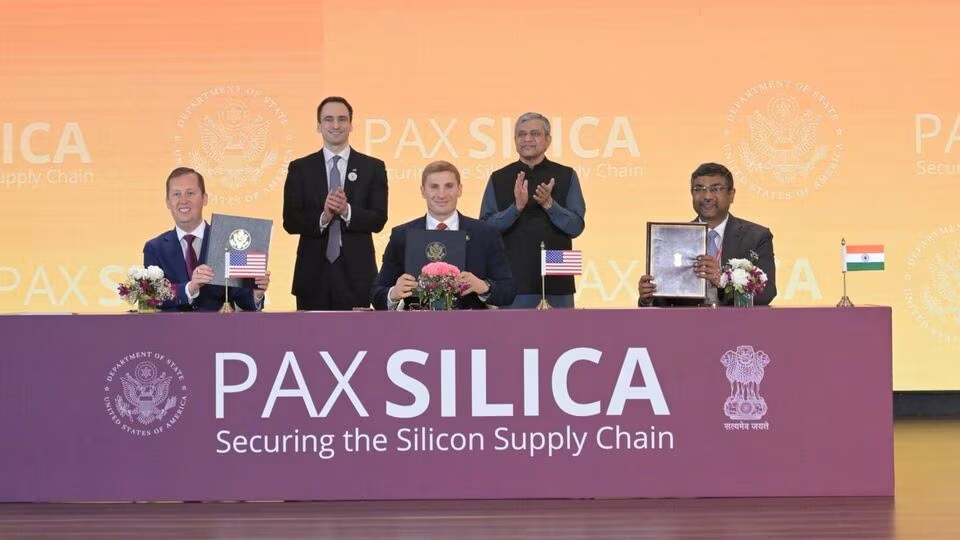
The 21st century global order is increasingly defined not by oil or steel, but by semiconductors, artificial intelligence (AI), and critical technologies. In this evolving geopolitical landscape, India’s formal induction into the Pax Silica coalition marks a significant strategic milestone. Pax Silica is a US-led initiative focused on securing AI and semiconductor supply chains among trusted partners. India’s entry signals its growing role in shaping technology governance, economic security, and strategic autonomy.
The development took place alongside the India AI Impact Summit, where US Ambassador to India Sergio Gor highlighted strengthening ties and indicated that US Secretary of State Marco Rubio would visit India soon. This move underscores renewed momentum in India–US technological cooperation.
For aspirants preparing under CUET Current affairs 2026 and Current Affairs 2026, Pax Silica must be studied through the lenses of geopolitics, economic security, supply chain resilience, and India’s strategic autonomy doctrine. Students enrolled in the best online coaching for CUET and online coaching for CUET should treat this not merely as diplomatic news but as structural global realignment.
Why in News
- India formally signed the Pax Silica declaration during the India AI Impact Summit.
- The coalition is led by the United States and focuses on AI and semiconductor supply-chain security.
- US Ambassador Sergio Gor stated that Secretary of State Marco Rubio will visit India soon.
- The move signals warming India–US ties after recent strain.
- The development strengthens India’s integration into trusted technology alliances.
Point-wise Summary of the Article
- Strategic Context: From Oil to Silicon
- The 20th century global order was shaped by oil and steel.
- The 21st century is shaped by semiconductors, AI, critical minerals, and digital infrastructure.
- Control over AI models and semiconductor supply chains influences economic and military power.
- Technological power is now central to national security.
- What is Pax Silica?
Pax Silica is:
- A US-led strategic initiative.
- Focused on AI and semiconductor supply chain security.
- Designed to align trusted partners into a cohesive technology bloc.
- A framework similar to US-India iCET (Initiative on Critical and Emerging Technologies).
It aims to:
- Secure semiconductor design and manufacturing chains.
- Reduce dependence on adversarial suppliers.
- Integrate economic security with strategic alliances.
- End of Frictionless Globalisation
The article argues that:
- Globalisation has shifted toward securitisation.
- Supply chains are increasingly seen as strategic assets.
- Nations cannot secure technology autonomy alone.
- Economic security now requires strategic partnerships.
- India’s Long Preparation
India has:
- Spent years laying groundwork via iCET.
- Invested in semiconductor initiatives.
- Launched the India Semiconductor Mission 2.0.
- Promoted domestic chip design and fabrication ecosystem.
Pax Silica provides a framework for these efforts to converge into a broader geopolitical bloc.
- India’s Strategic Advantages
India contributes:
- Human Capital
- Nearly 20% of global semiconductor design talent.
- Geostrategic Location
- Continental anchor outside volatile South China Sea.
- Alternative node in supply chains.
- Democratic Credibility
- Trusted governance framework for technology collaboration.
- Semiconductor Supply Chain Vulnerabilities
Current vulnerabilities include:
- High concentration in East Asia.
- Taiwan’s geopolitical exposure.
- Risk of chokepoints in advanced manufacturing.
India offers supply diversification.
- Economic Security vs Autarky
The article stresses:
- Autarky (complete self-reliance) is unrealistic.
- Strategic integration with trusted partners is necessary.
- Tech-nationalism must be balanced with global alliances.
- Domestic Transformation Link
Pax Silica integration supports:
- India Semiconductor Mission 2.0.
- AI ecosystem development.
- Manufacturing capacity building.
- Infrastructure investments.
- US Statement and Diplomatic Signals
US Ambassador Sergio Gor:
- Confirmed strengthening coalition.
- Indicated Secretary Marco Rubio’s India visit.
- Linked cooperation with Quad engagement.
This signals:
- Warming bilateral ties.
- Stronger Indo-Pacific strategic alignment.
Geopolitical Analysis for CUET 2026
- Strategic Autonomy Reinterpreted
India traditionally pursued non-alignment.
Now:
- Strategic autonomy is exercised through diversified partnerships.
- Coalitions like Pax Silica reflect pragmatic alignment.
- Technology as Geopolitical Currency
Semiconductors influence:
- AI systems.
- Defence systems.
- Surveillance infrastructure.
- Digital economy.
Control equals leverage.
- Economic Security Doctrine
Modern economic security includes:
- Securing supply chains.
- Protecting intellectual property.
- Limiting adversarial dependence.
- Building resilient trade frameworks.
- Quad Dimension
Pax Silica complements:
- Quad strategic cooperation.
- Indo-Pacific supply chain frameworks.
Legal and Policy Dimensions
- National Security and Trade Law
Technology controls increasingly intersect with:
- Export control regimes.
- WTO obligations.
- Bilateral trade agreements.
- Intellectual Property
India must:
- Strengthen patent ecosystem.
- Secure access to chip design IP.
- Balance domestic innovation with foreign collaboration.
- Industrial Policy
Semiconductor ecosystem requires:
- Subsidies.
- Infrastructure support.
- Long-term R&D investment.
- Public-private partnerships.
Opportunities and Risks
Opportunities
- Access to critical semiconductor equipment.
- Strategic positioning in Indo-Pacific.
- Boost to domestic AI innovation.
- Global supply chain integration.
- Enhanced diplomatic leverage.
Risks
- Geopolitical backlash.
- Supply chain shocks.
- Overdependence on US bloc.
- Domestic execution challenges.
Critical Reflection
The article warns:
- A seat at the table is only the beginning.
- Coalitions face geopolitical shocks.
- India must build overlapping technology alliances.
- Technological resilience requires agility.
Integration without domestic capability could reduce India to a hosting ground.
Conclusion
India’s entry into Pax Silica marks a decisive shift in global technology geopolitics. It signals India’s transition from peripheral participant to strategic actor in semiconductor governance. The coalition strengthens India’s economic security framework but also demands sustained domestic reform and institutional maturity.
For CUET Current affairs 2026, this topic integrates geopolitics, technology policy, economic law, and strategic studies. Students in the best online coaching for CUET and online coaching for CUET should frame arguments around strategic autonomy, global supply chain restructuring, and India’s industrial transformation.
Pax Silica is not merely diplomatic symbolism — it represents India’s positioning in the defining technological contest of the century.
Notes: Explanation of Peculiar Terms
- Pax Silica: US-led coalition focused on semiconductor and AI supply-chain security.
- iCET: India-US Initiative on Critical and Emerging Technologies.
- Autarky: Complete economic self-reliance.
- Securitisation: Framing economic issues as national security concerns.
- Quad: Strategic grouping of India, US, Japan, Australia.
- Semiconductor Mission 2.0: India’s policy initiative to develop domestic chip ecosystem.
- Supply Chain Resilience: Ability to withstand disruptions.
- Critical and Emerging Technologies (CETs): Technologies shaping future economic and military capabilities.
- Geostrategic Location: Strategic geographical positioning.