
India’s M.A.N.A.V. Vision for AI
Human-Centric Governance in the Age of Algorithms
(Ethics, Sovereignty, Digital Infrastructure & Global AI Diplomacy | CUET 2026 Analytical Brief for CUET Gurukul)
Introduction
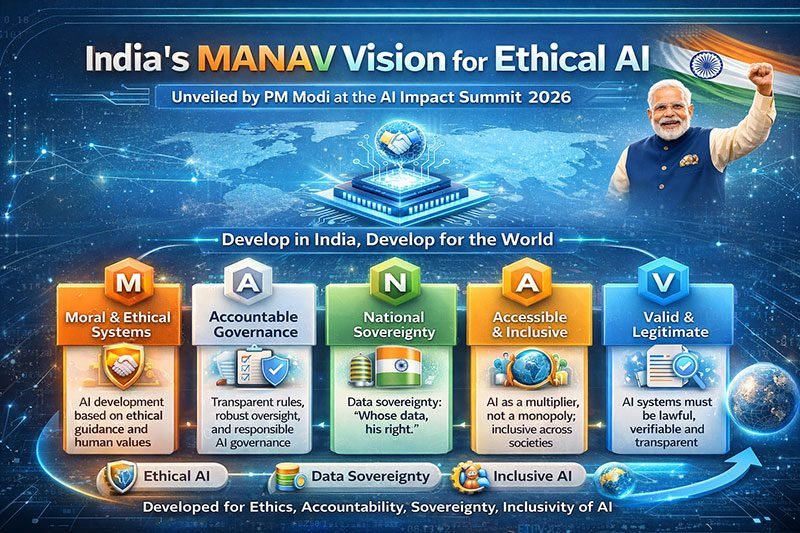
Artificial Intelligence (AI) is increasingly shaping governance, economy, defence, public health, and democratic processes worldwide. As global powers compete to dominate AI infrastructure and frontier models, India has articulated a distinctive framework: the M.A.N.A.V. Vision for AI, unveiled by the Prime Minister at the India-AI Impact Summit 2026.
Unlike purely innovation-driven or security-centric AI approaches, India’s M.A.N.A.V. framework positions AI as an extension of human aspirations, rooted in ethics, inclusion, and national sovereignty. It attempts to reconcile technological ambition with constitutional morality and global cooperation.
For aspirants preparing under CUET Current affairs 2026 and Current Affairs 2026, this development is crucial. It touches constitutional principles, digital governance, data protection, sovereignty, AI regulation, and international technology diplomacy. Students enrolled in the best online coaching for CUET and online coaching for CUET should study this as a structural shift in India’s digital statecraft.
Why in News
- The Prime Minister presented the M.A.N.A.V. Vision for AI at the India-AI Impact Summit 2026.
- The framework provides a human-centric governance model for AI development.
- India joined the US-led Pax Silica Initiative, reinforcing semiconductor and AI supply chain security.
- The summit marked a shift from fear-driven AI narratives to a “People, Planet, and Progress” approach.
- India set a Guinness World Record for AI responsibility pledges.
Point-wise Summary of the M.A.N.A.V. Vision
- Conceptual Foundation
- AI should not function as an autonomous force detached from society.
- AI must extend and amplify human aspirations.
- India treats AI as both:
- A strategic asset.
- A global common good.
- Meaning of M.A.N.A.V. (Five Pillars)**
M – Moral and Ethical Systems
- AI must adhere to ethical guidelines.
- Bias mitigation and fairness are core principles.
- Human dignity remains central.
A – Accountable Governance
- Transparent regulatory architecture.
- Oversight mechanisms embedded at ecosystem inception.
- Constitutional democratic values guide regulation.
N – National Sovereignty
- Data belongs to those who generate it.
- Sovereignty extends to digital infrastructure and algorithms.
- Strategic autonomy in AI infrastructure is essential.
A – Accessible and Inclusive
- AI should democratize opportunity.
- Avoid monopolistic concentration.
- Promote societal multiplier effects.
V – Valid and Legitimate Systems
- AI systems must be lawful.
- Verifiable outputs.
- Trustworthy and auditable architecture.
How India is Implementing the M.A.N.A.V. Vision
- Ensuring Moral and Ethical AI Systems
National Education Policy (NEP) 2020
- Integrates AI literacy and computational thinking.
- Encourages ethical digital citizenship.
Public Engagement
- Guinness World Record: 250,946 pledges in 24 hours for responsible AI.
- Ethical AI framed as collective civic responsibility.
- Accountable Governance Mechanisms
IndiaAI Mission
- Outlay exceeding ₹10,300 crore.
- Strengthens compute, data, skilling, and innovation.
- Governance embedded from design stage.
AI Governance Guidelines 2025
- Transparent regulatory structure.
- Rooted in trust, equity, and constitutional values.
- National Sovereignty in Digital Era
Beyond Territorial Borders
- Sovereignty includes:
- Data.
- Algorithms.
- Digital infrastructure.
Self-Reliance Initiatives
- India Semiconductor Mission.
- Secure digital public infrastructure.
- Domestic compute capacity strengthening.
Pax Silica Initiative
- US-led coalition to secure silicon supply chains.
- India formally joined at the Summit.
- Ensures strategic autonomy within collaborative framework.
- Accessible and Inclusive AI
Digital Public Infrastructure (DPI)
- Enables scalable AI solutions.
- Applications in:
- Healthcare.
- Agriculture.
- Education.
- Governance.
Democratizing Compute
- MeghRaj GI Cloud.
- IndiaAI Compute Portal.
- Shared GPU and TPU access for startups.
Grassroots Ecosystem
- IndiaAI Kosh (datasets).
- AI Data Labs Network.
- National Supercomputing Mission.
- Regulating AI for Trust and Safety
Tackling Deepfakes
- Synthetic media regulation to protect democracy.
- Algorithmic transparency requirements.
IT Amendment Rules, 2026
- Defines synthetically generated content.
- Enforces intermediary accountability.
Safe and Trusted AI Pillar
- Bias mitigation.
- Algorithmic auditing.
- Privacy-preserving design standards.
Pax Silica Initiative: Strategic Context
What is Pax Silica?
- US-led initiative (December 2025).
- Builds secure semiconductor supply chains.
- Counters coercive dependencies.
Objectives
- Promote joint ventures.
- Protect sensitive technologies.
- Build trusted ecosystems.
- Establish durable AI-powered economic order.
Member Nations
- Australia.
- Greece.
- Israel.
- Japan.
- Qatar.
- Republic of Korea.
- Singapore.
- UAE.
- UK.
India joined formally in 2026.
Evolution of the Global AI Agenda
AI Safety Summit 2023 – UK (Bletchley Park)
- Focus: Existential risks.
- Outcome: Bletchley Declaration.
- AI Safety Institutes created.
AI Seoul Summit – South Korea
- Balanced safety and innovation.
- Voluntary commitments adopted.
AI Action Summit 2025 – Paris
- Focus shifted to “Action.”
- 58 countries signed statement on inclusive and sustainable AI.
India-AI Impact Summit 2026
- First AI summit in Global South.
- Focus on:
- Real-world problem solving.
- Democratised access.
- Development-centric AI.
Future Summits
- 2027: Switzerland (Geneva).
- 2028: UAE.
Legal and Constitutional Dimensions
- Data Sovereignty
Linked to:
- Right to Privacy (Article 21).
- Data Protection laws.
- Digital autonomy.
- Accountability and Rule of Law
AI systems must:
- Be legally auditable.
- Avoid arbitrariness.
- Comply with constitutional standards.
- Democratic Governance
AI governance rooted in:
- Transparency.
- Citizen oversight.
- Regulatory checks and balances.
Strategic Implications for India
- Tech-Nationalism without Isolation
India avoids:
- Alarmist AI narratives.
- Pure autarky.
Instead promotes collaborative sovereignty.
- Development-Centric AI
Focus on:
- Agriculture yield optimisation.
- Healthcare diagnostics.
- Education accessibility.
- Global South Leadership
India champions:
- Inclusion of developing nations.
- Preventing AI concentration in few economies.
Critical Evaluation
Strengths
- Balanced ethical and strategic approach.
- Institutionalised governance mechanisms.
- Infrastructure-driven democratisation.
- Strong diplomatic positioning.
Challenges
- Implementation gaps.
- Regulatory clarity vs innovation balance.
- Infrastructure funding sustainability.
- Deepfake enforcement complexities.
Conclusion
Through the M.A.N.A.V. framework, India is articulating a uniquely human-centric model of AI governance that integrates morality, accountability, sovereignty, inclusion, and legality. It represents a shift from reactive regulation to proactive architecture-building.
As the global AI discourse moves from safety fears to inclusive development, India seeks to ensure that artificial intelligence strengthens human dignity, democratic values, and equitable growth.
For CUET Current affairs 2026 and Current Affairs 2026, the M.A.N.A.V. vision reflects the intersection of constitutional law, digital policy, global diplomacy, and industrial strategy. Students enrolled in the best online coaching for CUET and online coaching for CUET must prepare structured arguments on AI ethics, sovereignty, and governance reform.
India’s AI moment is not merely technological — it is civilizational and constitutional.
Notes: Explanation of Peculiar Terms
- M.A.N.A.V.: Acronym representing five pillars of India’s AI vision.
- Digital Sovereignty: Control over national data and digital infrastructure.
- DPI (Digital Public Infrastructure): Foundational digital systems enabling services.
- Deepfakes: AI-generated synthetic media.
- Algorithmic Auditing: Independent review of AI decision-making processes.
- GPU/TPU: High-performance processors used in AI computing.
- Pax Silica: US-led semiconductor supply chain coalition.
- AI Safety Institutes: Institutions assessing frontier model risks.
- Strategic Autonomy: Independent decision-making in global geopolitics.